Sunday, February 14, 2016

Social Imagination

Social imagination is a powerful thing! We see teachers and groups of people always tackling the issues of social justice and the events that are going on around the world. In chapter 17 we learned about multiple projects that were designed to encourage children's social imagination. In Maxine Greene's video she stated "Learning is very interesting," and she is still interested in learning. Then she proceeds to say that she wishes children would think learning is interesting and the way to do that is to, "communicate to the children the excitement of education and seeing new things, possibilities." She then goes on to talk about her worry that children do not see the importance of learning in school. In the art room we need to establish the idea that everyone is free to speak their mind and opinions without the fear of being judged. This idea relates me to my classroom management statement that I have on my website. http://lindseyjerdee.wix.com/arteducation#!my-philosophy/u1rv5 We need to talk about how to create a safe environment and what that entails. There are many ideas that go into creating a safe environment like how to be a good listener, respectful comments, body language, and discussing topics when there are differing opinions.

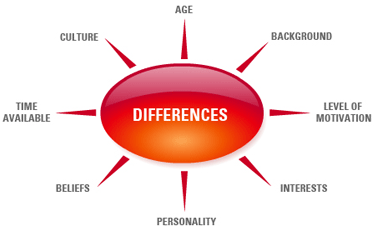
We all have our own ideas and values and that can hold true when talking about social responsibility, but as a teacher we need to keep from pushing our values onto our students. In our classrooms there will be differences among our students. We will need to talk about all sides of the topic, give opposing ideas, sort of play the devils advocate and have our students to continue to think and evaluate the situation. By allowing students to problem solve and research the topics it makes the student come to a conclusion and their own ideas without pushing our own values. Being aware of what I say and how I say something is also very important so I do not sound subjective towards a certain topic.


I feel that when talking about social imagination that like all topics some students will understand it right off the bat and others will need further discussion. For myself I feel the best way to teach social imagination would to first start a discussion and then break into small groups about what it is and the definition. Then I would go farther and show examples of how to use social imagination and the two social justice projects that we read about in chapter 17. Having the students make connections between the projects and understanding how "Fallen Heroes" and "Hopes, Wishes, Regrets" made impacts in similar and different ways. I think that when the students are making personal connections that they are more likely to act on their ideas and make a difference. Showing students examples and ideas can spark their motivation into start a project that they are invested in. Pushing students to be creative problem solvers and to create personal connections to the topics will allow students to understand the importance of social justice and social imagination.

Sunday, February 7, 2016

Reading a Graphic Novel

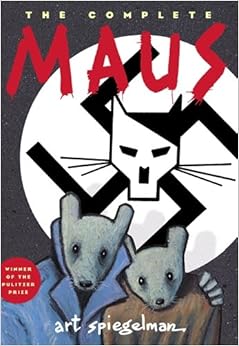
I have mentioned before that I previously had never read a graphic novel, but that has now changed. I have now finished Maus 1 and 2 written by Art Spiegelman. This was a new experience for me and I am still debating how I feel. I liked the idea of being able to follow along the story with pictures, but I feel at the same time I wish  I had more details and descriptions. My heart ached for more information and more story. With that said overall I did really enjoy reading my first graphic novel.

When reading my graphic novels I came across multiple parts that I considered my favorite. After comparing all my favorite parts I realized that they all shared a common theme. I was interested in the parts where even though the Jews were suppose to be the "bad" guys people that were suppose to be fighting against them sometimes would still help. In Maus 2 on page 32 and 33 this scene is about being in a concentration camp and still being able to trade to help one another out. This trading scenario happened throughout both books and that is one of the  reasons that he was able to survive the way he did.


This book relates the idea of conflict because it is about World War 2 and being of a different race. This book addresses the Holocaust in a different format as most by making the characters into animals. By formatting the book so the characters are animals children are learning about the Holocaust and the war in a different way. In the beginning of Maus 1 on page 19 there is a scene where Vladek is meeting his girlfriend's parents and he is snooping around and finds that she has pills hidden in her closet. He then goes to the extremes of having a friend look up what the pills are for. I believe this is still a situation that teenagers will run into. I do not think that the best advice is to snoop around, but this is still a common issue that is true and prevalent today. A bigger issue of these stories is the idea of growing up with a family member who was involved in a traumatic situation and that traumatic situation still having an impact on life. When I was reading this story it made me think of people who struggled with PTSD and people who had memories that were still very real. In Maus 2 there is a scene where Art and Vladek are speaking and Vladek will not through something away because he does not like to waste anything. He states it is because of Hitler and how he used to have nothing and he will not waste things. At the end of the Maus 2 on pages 44-46 Art is seeing a therapist and they are talking about how maybe Art and Vladek had the relationship they did because of the war and how it affected Vladek long term. Again, I feel that this can relate to a teenager because sometimes we only see one side, our side. This story can help a growing teenager with struggles because it shows a lot about communication and talking with a parent.

Before this course I have never heard of the story Maus and I would probably not have come across it for a long time. But I am glad I did have the chance to read this graphic novel and see how this book can identify with struggles teenagers go through. Now days teenagers most likely can not relate directly to the Holocaust, but they can connect to communicating with parents, loosing loved ones, working with family members that may struggle with the past, and/or relationships.


Sunday, January 31, 2016

Comics in Childhood

Looking back to when I was a child I did not find comics interesting, but I did not have access to comics either. Once in a blue moon we would get the newspaper and I would read the comics in the back, but that was only a couple times a year. I lived my childhood with no idea that comics outside the newspaper existed until I was in about sixth grade. A peer was reading a comic that had to do with super heroes. At this point in time I was not interested. Now as an adult I still do not find comics interesting. I have looked through them and tried to understand that craze is about.

As I stated above I do not read comics nor graphic novels. I have tried to read graphic novels before and they just do not keep my attention or interest. I love to read and I love images, but I just do not enjoy reading graphic novels. But when thinking about middle school  and high school aged kids I think that they love comics and graphic novels because they are different from reading traditional novels. I also believe it is because they make graphic novels and comics for every age that kids can relate to. Teaching an art lesson around comics and graphic novels is a good idea because they are popular and kids are interested in them. Being able to bring what kids are interested in into the classroom is important.

When researching and looking at comics I was surprised  to see how many there were. I knew that there were more comics than just superheroes, but there are a lot of other comics that are about other subjects. I came across a website that was discussing the 20 Best Comics of 2015 and the website gave a short synapses about each one. http://www.pastemagazine.com/articles/2015/07/the-20-best-comics-of-2015-so-far.html There were only two comics on this list that I had ever heard of. Finding this article really helped me realize that there can be comics about almost everything and that finding a comic that students can relate to or enjoy is not that difficult. I think I need to spend more time looking at comics and graphic novels so that I can become better acquainted and bring that information into my classroom.


Sunday, January 24, 2016

Art Journals

PictureWhen thinking about journals being used in art there are many different ways this can be done. Journals are not just used for writing, but can be used to incorporate art and writing into one. The journal itself can be turned into a piece of work. Images, sketches, text, collages, and painting are all ways that can be incorporated into a journal and it doesn't have to stop there. There are many artists who used journals in their art practices: Leonardo Da Vinci, Emily Martin, Dan Eldon, Sabrina Ward Harrison, Lynda Barry, and Jennifer New are just a few. Emily Martin is a book maker, author, and illustrator. Below is a picture of a book she created and then an awesome video about the inspirations and ideas behind the book. https://www.youtube.com/watch?v=QYZRslUPViE&noredirect=1 

Where as Leonardo who was a "Renaissance Man" used journals to write down and document his ideas, artwork, scientific findings, and his invention ideas. Journals are an important resource in art that are sometimes overlooked.


Besides the functionality of a journal I believe that students who use journals are able to express themselves without worry A journal can be a personal object that does not need to be shared. Students can sketch their ideas and write down their thoughts to clarify what they are thinking without the pressure. Journals are great for students to problem solve in. Students could buy a journal, but why not teach the skill of bookmaking and talk about how bookmaking can be an art. Before entering college I did not even know bookmaking was considered an art. Students can learn about paper making, book binding, and many other skills while learning to make their own journal. This is a great way to get to know your students.


Spread 128 - My Journal-My Garden - 72In my classroom I hope to have my students create their own journal to use throughout the course. I want the students to learn the skills of bookmaking and learn about bookmaking as an art form and also create something that they can use. Students can then use their journals to write down and sketch their ideas throughout the course. Besides just using a journal to document their ideas I would like the students to create a blog where they can interact with their peers. I will require the students to create a blog to use to share their artwork, influences/inspirations, and their problems/successes in art. I want to extend the classroom outside of the four walls of the art room. Students will then have a journal to keep their ideas in without having the pressure to share and then be able to share what they do want on the blog.

While looking at artists that use journals I came across another artist that we did not talk about who I fell in love with this journaling style. The above artist is Brian Kasstle. He has his own blog with his journals. https://apaperbear.wordpress.com/tag/art-journals/page/2/
Sunday, January 17, 2016

Social Justice

When looking at social justice today in our world I feel that there is just as much injustice happening as justice. Social injustice can be found when you turn on the news, read a newspaper, or even when looking on Facebook. Right now a lot of attention is being placed on injustice and being put in the media where it spreads like wild fire. Social justice and injustice can play a huge role in my career as an art educator because of how prevalent it is in our culture today.

How can social justice/injustice play a major role in art education? Artists create art that is influenced by what is going on around them and what is happening in their life. Artists respond to their emotions and portray these emotions through their art.Social justice/injustice is all around us and easily accessible. As a future art educator social justice/injustice is an avenue that students can explore and create art in response to their ideas and emotions. Students are all affected by social justice/injustice and this can be a way for them to express their thoughts to what could be a personal issue. When students are researching and creating their projects this can help them develop their identities of who they are because it shows what the student may support or disagree with. Students are able to research and understand what their topic may have to do with social justice and the information may or may not change their views on a topic. Students can learn more about themselves, the world, and their own beliefs.

Social justice/injustice is important when considering and planning my curriculum because it can be a sensitive topic that needs to be addressed correctly. Depending on the community there could be specific social justice/injustice issues happening that are related to just that community. Being aware is the key. It is also important to consider when planning the curriculum about what do I want to the students to get out of this lesson and what is the goal of the lesson. This idea is important in all lessons, but social justice/injustice is a big topic and students need to learn about the topic, understand the topic, and be able to translate their ideas and thoughts.

Art is a way of expressing yourself. There is no wrong or right way and no definite rules about how to do it. But in art there are many valuable skills that can be developed and made stronger when creating art. Collaborating, planning, reflecting, and being driven are all skills can be developed. When creating a lesson, especially around social justice/injustice, these skills are brought forth to help create a successful project.